Published: www.period.nl/quotes/evolutie-van-de-menstruatiedans
Date: 10th April 2026
Translation: Google
The earliest surviving statue of a female dancer in South Asia is the ten-centimetre tall, ‘Dancing Girl’ bronze figurine from the Mohenjo-Daro, Indus Valley Civilization, (2500–2000 BCE.) The figure’s contrapposto, weight on one leg, hip thrust out, and bent elbow mirrors a Bharatnatyam posture. Her teen age, defiant attitude, and ornate jewellery provoked me to ask: What kind of dance had she dressed up for and could it by any chance have been a menstrual dance? Sampradaya is Sanskrit for evolving tradition, and I wonder if this is true for menstrual dances, if they exist.
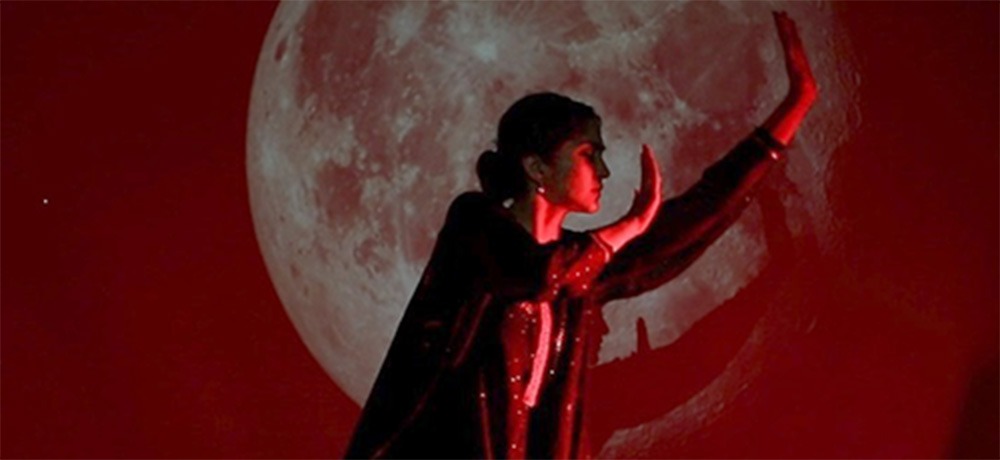
How dance might be used to interpret and convey the movement inside the menstruating body came to me as an idea while editing Period Matters: Menstruation in South Asia. I contacted a Pakistani classical dancer, Amna Mawaz Khan, and commissioned her to interpret her menstrual cycle using her own experiences and classical Indian raags. Using Bharatanatyam and Kathak forms, she choreographed a dance where she sought to reclaim an ‘imagined, ancient menstrual dance tradition.’ Through rhythmic motions and movements in the form of nrittya (expressive) and nritta (technical) dance steps she conveys how her experience of menstruation include humiliation and embarrassment, confusion and anger, and even at times, disappointment when it marked the end of an unsuccessful fertility window. Her dance, Raqs-e-Mahvaari, focused on conveying her shame and power through rawaangi (flow), mudras (hand gestures) and feet movements. Through her dance she conveyed her defiance and resistance to patriarchy which perpetuated these myths. Through push and pull, slow, fluid hand gestures, a steady beat and flow in steps, raised arms and pivot turns, she mirrored the early stage of menstruation. As heat and intensity increases in the body during the menstrual cycle, Amna demonstrated this through whirling bhramari chakars, or circles drawn on the floor by her feet covered in red paint. Throughout the dance emphasises a feminine divine energy that is permanent. Amna’s dance is a contemporary, solo, personal interpretation of menstruation and when it featured in Period Matters, it was the first time a book by an Indian publisher had included a QR code for a dance.
Dance practices provide a window into how religious rituals and the female body are negotiated through performative art. Menstrual dances in South Asia appear to be rare due to religious and cultural myths that frame menstruation as impure and private, not celebratory. The decline of matrilineal systems and missionary conversions have possibly contributed to suppression of dance rituals honouring fertility. Patriarchal norms rooted in Brahmanical Hinduism and Islamic purity codes which associate periods with pollution enforce seclusion during menstruation and bar women from participating in public spaces, including temples, funerals, and marriages. This restriction of movement during menstruation translates into a stifling of any performative expression. In Buddhist Bhutan, menstruating women are excluded from tshechu dances. Where there are examples, these usually involve rituals celebrating fertility, puberty, or seasonal cycles rather than menstruation.
Like Amna, Indian artist, Mallika Sarabhai’s, Shakti also uses Bharatanatyam. Taking a modern, feminist lens, Sarabhai blends folk elements with classical forms to illustrate goddess embodiment, and female performance, rather than male, contrary to tradition. In her dance, a red sari symbolises blood, violence, and rebirth echoing Shakti’s fiery energy. Spiralling arms and floor undulations in the dance mimic the cycles of menstruation and childbirth, while subverting Bharatanatyam’s ‘pure’ geometry, Sarabhai’s intention being to critique established rituals by incorporating ‘gestures from everyday life and martial arts.’ Her dance reinterprets goddess myths to show Shakti, Devi, Kali and Sita as ‘raw, revolutionary female powers,’ who resist patriarchy. In the dance climax, the dancer’s red sari is soaking wet, her tongue hangs out, and her eyes roll to embody theyyam, or the visceral peak of Kali’s ferocity.
Sarabhai’s work was inspired by Mutiyettu Theyyam, from the Vannan, in Kerala whose menstruation dance ritual captures a unique blend of devotion, myth, and communal celebration. Mutiyettu or the embodying ritual of Badrakali (the name for goddess Kali while she is menstruating) is depicted through ferocious stomping, and hand gestures or mudras. Theyyam, or the possession ceremony, is shown by a male dancer performing trance like spinning and intense abhinaya, or expressive eye work to symbolise the embodiment of the goddess Bhagavati’s ferocity during menstruation. The performance takes place in a temple or sacred grove and after many hours of intonation and abstinence, the male dancer enters in a trance state, stomping his feet, waving a sword, and leaping through fire show Bhagavati’s energy. His face is painted, and he wears a crown and a red cloth around his waist to symbolize menstrual blood. His circular spins represent cyclical renewal, while the red cloth symbolise the earth’s fertility. Communal chanting includes the phrase, ‘Her blood is life. Her cycle is sacred. Her power protects us.’ The Vannan dance, though performed by a male dancer, highlights the female divine during menstruation. Four hundred variants of Theyyam exist but only the Mutiyettu is tied to menstrual symbolism.
The Bison Horn Maria tribe, in Bastar, Chhattisgarh, India, also have a menstrual dance known as the Lingo Pen ritual. When a girl gets her first period, or rajswala or pen puja, she is kept secluded in a hut, or gondhal. When her period is complete, she is bathed, adorned with mahua flowers, beads, cowrie shells, peacock feathers, and draped in a red sari to symbolise her passage to fertility. She is then seated in the middle of the community, who encircle her in a joyous dance. The men wear bison horn headdresses and perform hulki or stomping, and saila or stick-clashing. Against the backdrop of dhol, flutes, and bison trumpets the phallic deity, the deity Lingo, is invoked to bless the girl’s fertility. Other tribes in Kondagaon and Narayanpur also perform similar dances revering menstruation as a sacred, communal milestone.
Another example exists in the Ho tribe, in Singhbhum, Jharkhand, India. The Mage Porob, takes place after the girl with her first period has been secluded for seven days in a kurmi ghar or menstrual hut. Just as in the Lingo Pen ritual, the girl enters the dance after being bathed, adorned in a white sari, marked with rice paste on her forehead and flowers in her hair. Unlike Lingo Pen and Theyyam, the Mage Porob is led by women dancing in circular formations to mirror the renewing circle of life. Accompanied by drums, flutes and songs in praise of menstrual blood as life-giving, men also join the dance with sticks, to appreciate Dharti Mai or Mother Earth’s fertility.
These tribal menstrual dances are completely unlike in Raqs-e-Mahvaari, where the dancer, Amna Mawaz Khan, was centre stage, interpreted her experience on her own terms and claimed menstruation as a time of embodied female power. In contrast to Amna, in the communal dances, the girl being initiated sat passively in the middle, as the community danced and honoured her transition to womanhood. While Amna’s dance was privately choreographed, individual and preformative, the community dances were spontaneous, public and participatory. They included rituals of seclusion and evocation of specific goddess deities, while Amna’s dance had no religious rituals and hearkened to the idea of a universal female energy. The motivations for the menstrual dances were different and so were their movements and they reminded me of yet another.
When my niece, in Kenya, started her first period, she was away at a school camp. She informed her teacher who rounded up some of the other girls and asked them to encircle my niece. What followed was a spontaneous, initiation dance. My stunned niece, who had been dreading her period, realised she was being celebrated. Could that unplanned, joyful, and memorable rite of passage be called a menstrual dance? And are there places where such dances occur?
In Chitral, Pakistan, I visited a bashali, or maternity home, where the women of the Kalash Valley went to rest during their period. In this multi bedroom house for menstruating women, they met to rest, counsel each other, gossip, and share stories. They also embroidered, sang, and performed rituals to their fertility goddess Dezalik. They also danced. This was not a specifically choreographed for the community or an audience. It was simply women on their period, dancing for and with women who were also on their period. What better example of a living celebration of womanhood, fertility, and feminine independence? As the community proudly claims: ‘homa istrizia asan,’ – our women are free.
Evolving menstrual dance forms, from the defiant contrapposto of the Dancing Girl to Amna Mawaz Khan’s solo Raqs-e-Mahvaari, the trance-possessed ferocity of Mutiyettu Theyyam, the communal circles of Lingo Pen and Mage Porob, to the unscripted joy at the bashali and at my niece’s school camp, trace a sampradaya of reclamation, resistance, and reimagination. Once confined by seclusion and shame, the menstruating body now chooses to express itself through movement: a hip thrust against patriarchal stillness, whirling chakars that paint cycles of blood and renewal on the earth, stomping feet that invoke divine fury, or spontaneous circles that shatter isolation. In every pivot, every mudra, every shared step, women seize the rhythm of their own flow, as the primal pulse of life, demanding the world witness and make space for its power.
Bibliography
S.C. Mohanty fieldwork (1970s); G.N. Devy oral archives (2000s); Adivasi Ekta Manch reports (2024)
Rich Freeman, Purity and Violence (1998); Bindu Ramachandran fieldwork (2008)
Verrier Elwin, The Maria and Their Ghotul (1947); IGNCA films (1990s); Tribal Research Institute, Chhattisgarh (2023)