Published on Usawa Literary Review, March 2026
usawa.in/matchbox/parwana-fayyazs-three-dolls-and-the-politics-of-femininity
Afghani poet Parwana Fayyaz’s poem Three Dolls is shaped by her lived experiences of war, exile and state oppression. Caught in the crossfire of foreign invasions, civil war, and Taliban rule, Fayyaz’s poem focuses on the small, intimate acts of survival during devastation. Three Dolls struck a deep chord with me, because like Fayyaz, I also have sisters.
When I was growing up in Kenya in the 1980’s, my mother’s sister, my Masi, made my baby sister a doll. It wasn’t a doll in the usual sense, but more like a cotton pillowcase shaped like a doll’s body, with a printed face and strawberry dress which my aunt had stuffed and sewn using blanket stitches around the edges. I remember how it arrived in a parcel from Mombasa, where she lived, to Nairobi, where we were, and the excitement at receiving it. It was a symbol of my Masi’s affection for us. My sister named her Polly and would sleep with it under her head every night, as though the doll offered her some protection.
Much earlier, when I was two years old, another Masi, had given me a doll. My parents had travelled abroad for a few months and left me in the care of relatives. My Masi visited me there every evening, and much later she told me how I had cried inconsolably, and she had hoped the doll with silver hair would cheer me. I named the doll Silvie when I was older, and she hung around in the back of a cupboard until my late twenties when I finally gave her up. Polly too, stuck around for many years, and only, after a decade of being washed and dried in the sun, when she was a faded, unshapely figure of just lumps of cotton wool, she was laid to rest.
Similarly, in her poem, Fayyaz writes about how her mother lovingly crafted three dolls from garden sticks, pillow stuffing, and scraps of fabric.
Their figures were made with sticks gathered from our neighbour’s garden…rolled white cotton fabric around the stick frames to create a skin for each doll….cotton extracted from an old pillow….black and red yarns…our dolls came alive,
with each stitch of my mother’s sewing needle.
Fayyaz speaks of the dolls in a personal, conversational tone and how each of her sisters chose a doll.
And finally, we named our dolls. Mine with a skirt of royal green was the oldest and tallest, And I called her Duur. Pearl. Shabnam chose a skirt of bright yellow
and called her doll, Pari. Angel. And our youngest sister, Gohar, chose deep blue fabric, and named her doll, Raang. Color.
For Fayaaz and her sisters Duur, Pari, Raang, became symbols of comfort, and resilience, for them individually and collectively in the family memory. The dolls became an intergenerational, eternal connection between their mother and themselves.
They lived longer than our childhoods.
Through the poem, Fayyaz honours her mother’s act of crafting and demonstrates her agency and resilience: the creative act of making dolls by a mother for her daughters, in the middle of the ravages of war, becomes a form of quiet resistance. The dolls take on a greater significance as symbols of connection to the past suggesting that familial love can survive even in the most extreme circumstances.
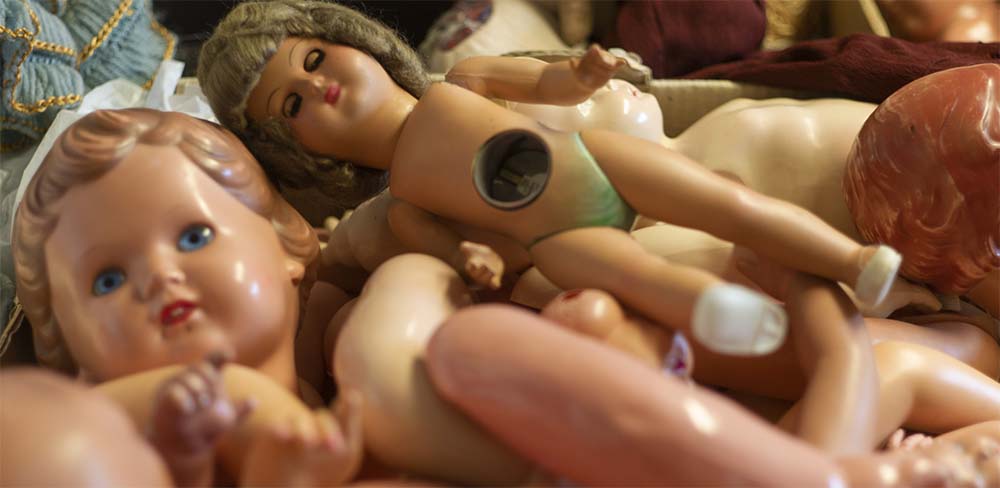
Walking through the streets of London, recently, I came across a plastic doll lying on the pavement. The head was by the dustbin, the body across the street. The face, though still fixed in a smile, was missing one of its bright blue eyes. The empty socket, even though it was just on a toy, gave me the shivers. There was something violently careless in how the doll had been discarded, the force in its beheading, and a kind of indifference in the separation of head and body. How do we discard memories and how do we hold onto them? Did this doll ever have a name and who did she belong to?
I was reminded of my visit to the Afghan war rugs exhibition at the British Museum. As I wandered among the handwoven depictions of helicopters, tanks, and battlefields, thinking about how domestic and violent histories are often stitched together, sometimes literally, I noticed in one of the glass cabinets a small, doll-sized burqa. Curiously, the exhibit label said ‘the dress’ was sold to soldiers who came from abroad to take home as gifts, presumably for their daughters to dress their dolls. Or possibly, the ‘miniature burqas’ were used by the foreign soldiers as covers to hide their bottles of alcohol from immediate detection. This repurposing of ‘doll dresses’ for men reminded me of Iranian poet, Forough Farrokhzad’s poem, The Wind-Up Doll. In her poem she discusses how women were often like dolls, reduced to being playthings for men, mechanical and disposable.
Farrokhzad’s Wind-Up Doll, was written in the early 1960s, when the poet was living during a time of profound political and cultural change in Iran. Under the rule of Mohammad Reza Shah, Iran was undergoing a rapid process of modernization, which included social and legal reforms aimed at improving the status of women. However, these reforms were contradictory; on the one hand they promoted a Westernised vision of women’s roles while on the other, they reinforced traditional, patriarchal structures. Farrokhzad, a feminist poet, was one of the few to critique the State and its repression and objectification of women.
The Wind-Up Doll addresses the emotional and social confinement of women under the Iranian regime, and gives voice to the women living under patriarchy.
Like a wind-up doll one can look out
at the world through glass eyes,
spend years inside a felt box,
body stuffed with straw,
wrapped in layers of dainty lace.
The image of the wind-up doll in Farrokhzad’s poem is a metaphor for a passive, manipulated femininity and a symbol of how under the Iranian State, men in power reduced women to mere objects of display, satisfaction, and obedience.
Though separated by time and cultural contexts, both Fayyaz and Farrokhzad’s poems highlight the doll as a political metaphor and a site where power, gender, and violence intersect during war. While, Fayyaz’s Three Dolls reclaims the doll as a symbol of maternal care, memory, and survival, Farrokhzad’s Wind-Up Doll explores it as a critique of repression and emotional stagnation. In Fayyaz’s poem, the doll symbolises creative survival, and resistance to state violence, but in Farrokhzad’s case, the doll represents how the state and patriarchy objectify women and coerce them into embodying societal expectations. While in Fayyaz’s poem, the dolls are named and dressed in specific colours and fabrics endowing them with a personality and identity, in Farrokhzad’s poem the wind-up doll is unnamed- she represents every woman. While Fayyaz’s dolls speak of resilience, care, and emotional continuity, Farrokhzad’s wind-up doll, with its passivity and lifelessness is about the state’s silencing of women’s voices.
I return to that disturbing moment where I found the doll carelessly discarded on Tavistock Place in London. On the one hand I am reminded of the suffocating conformity and disposability of Farrokhzad’s wind-up doll in Iran, while at the same time, I recall the tender defiance of Fayyaz’s mother’s handmade creations in Afghanistan which takes me back to my own childhood in Kenya and the dolls in my family. Across contexts and generations, the doll remains a powerful reminder of solidarity and sisterhood.
Three Dolls
During the wars,
my mother made our clothes
and our toys.
For her three daughters,
she made dresses and once,
she made us each a doll.
Their figures were made with sticks
gathered from our neighbour’s garden.
She rolled white cotton fabric
around the stick frames
to create a skin for each doll.
Then she fattened the skin
with cotton extracted from an old pillow.
With black and red yarns bought from
uncle Farid’s store, my mother created faces.
A unique face for each doll.
Large black eyes, thick eyelashes and eyebrows,
Long black hair, a smudge of black for each nose.
And lips in red.
Our dolls came alive,
with each stitch of my mother’s sewing needle.
We dyed their cheeks with red rose-petals,
and fashioned skirts from bits of fabric,
from my mother’s sewing basket.
And finally, we named our dolls.
Mine with a skirt of royal green was the oldest and tallest,
And I called her Duur. Pearl.
Shabnam chose a skirt of bright yellow
and called her doll, Pari. Angel.
And our youngest sister, Gohar, chose deep blue fabric,
and named her doll, Raang. Color.
They lived longer than our childhoods.
From Forty Names, Carcanet Press, Parwana Fayyaz
Wind-Up Doll
Even more, oh yes,
one can remain silent even more.
Inside eternal hours
one can fix lifeless eyes
on the smoke of a cigarette,
on a cup’s form,
the carpet’s faded flowers,
or on imaginary writings on the wall.
With stiff claws one can whisk
the curtains aside, look outside.
It’s streaming rain.
A child with a balloon bouquet
cowers beneath a canopy. A rickety cart
flees the deserted square in haste.
One can remain fixed in one place, here
beside this curtain…but deaf, but blind.
With an alien voice, utterly false,
one can cry out: I love!
In the oppressive arms of a man
one can be a robust, beautiful female–
skin like leather tablecloth,
breasts large and hard.
One can stain the sinlessness of love
in the bed of a drunk, a madman, a tramp.
One can cunningly belittle
every perplexing puzzle.
Alone, occupy oneself with crosswords,
content with unimportant words,
yes, unimportant letters, no more than five or six.
One can spend a lifetime kneeling,
head bowed,
before the cold altar of the Imams,
find God inside an anonymous grave,
faith in a few paltry coins.
One can rot inside a mosque’s chamber,
an old woman, prayers dripping from lips.
Whatever the equation, one can always be a zero,
yielding nothing, whether added, subtracted, or multiplied.
One can think your eyes are buttons from an old ragged shoe
caught in a web of anger.
One can evaporate like water from one’s own gutter.
With shame one can hide a beautiful moment
like a dark, comic instant photo
rammed deep into a wooden chest.
Inside a day’s empty frame one can mount
the portrait of a condemned, a vanquished,
a crucified. Cover the gaps in the walls
with silly, meaningless drawings.
Like a wind-up doll one can look out
at the world through glass eyes,
spend years inside a felt box,
body stuffed with straw,
wrapped in layers of dainty lace.
With every salacious squeeze of one’s hand,
for no reason one can cry:
Ah, how blessed, how happy I am!
From Sin, and other poems, Forough Farrokhzad, translated by Shole Wolpe