Published in The Chakkar.
Farah Ahamed examines the complexities of motherhood and desire in Saadat Hasan Manto’s Mummy, Mahesh Manjrekar’s Astitva, and Deepa Mehta’s Water.
In Saadat Hasan Manto’s 1954 short story, “Mummy” is Stella Jackson, an Anglo-Indian procuress who operates a brothel in Poona called ‘Saeeda Cottage.’ She is called Mummy by her girls and her clients because she has a “maternal love for all” (292). Stella is an aging white woman with garish, loud makeup, “so grossly painted that it hurt the eye” (292) and while she may have been beautiful once, she is now an aged, unglamorous old hag in a “soiled nightgown” (292). This image is contrasted a few pages later, when Stella applies makeup to consciously transform her identity into a motherly brothel owner.
Through Stella, Manto challenges stereotypical ideas of motherhood, maternal care, and desire. “Her world was simple and beautiful and reassuring. Yes, there was drinking and sex and a general lack of seriousness, but one felt no emotional unease. It was like the protruding belly of a pregnant women; a bit odd, but perfectly innocent and immediately compressible” (307).
Why are sexual desire and motherhood considered incompatible? Why are mothers, either biological mothers or maternal figures, ‘othered’ when they resist being confined to the Madonna role? Speaking of women and identities, novelist Shashi Deshpande has said that, “For a woman, intelligence is always a burden… We like our women not to think.” It also seems that we don’t want them to feel, either.
There is a pervasive sexist assumption that women should be classified as either the Madonna, frigid, or whore. In Damned Whores and God’s Police (2016), the feminist Anne Summers argued that these stereotypes cast women either as virtuous mothers tasked with civilising society, or as ‘bad girls’ who refuse to conform, and are consequently spurned by society. In India, mythological representations based on the ‘divine mother’ have confined women to idealised roles which dictate that mothers should be fertile, self-sacrificing, patient, and with unconditional love. This notion of motherhood, embedded in patriarchy, is oppressive because it limits a woman’s identity to her roles as daughter, wife, and mother, and denies her any individual aspirations. A woman’s autonomy and ambitions—whether personal or professional—are irrelevant, and she is forced to conform to culturally acceptable behaviour.
In “Mummy,” Manto asks: is motherhood incompatible with a profession that involves the gratification of men’s sexual desires? Commenting on the social status of female sex workers, Sumanta Banerjee, in her book, ‘Dangerous Outcast, The Prostitute in Nineteenth Century Bengal’ (1980) notes how, “the prostitute also is pushed into a strictly defined narrow space. She is condemned to the exclusive role of a specialist in sexual entertainment. Stripped of all emotional and intellectual attributes, she becomes the female body… expected to produce the regular nocturnal fantasy of pleasure she represents the ultimate in alienation…”
Stella is protective over the Anglo-Indian girls she employees at Saeeda Cottage, including her fifteen-year-old daughter, Phyllis, who is a “platinum blonde” born “from someone” (300). At the same time, Stella ensures that her male clients—including her favourite, Chadha—are properly entertained. This duality may raise questions about Stella from the reader’s perspective; but for Stella herself, the balancing act seems natural. She maintains her distance from society’s judgmental gaze by keeping the curtains at Saeeda cottage drawn, which creates a hazy, sheltered, and somewhat claustrophobic atmosphere, while also metaphorically shielding those within.
As the story unfolds, one evening, when Chadha is drunk he “pulled Phyllis towards him, squeezed her against his chest in a passionate B-grade movie embrace.” (304) Stella’s protective maternal instinct is triggered. “‘Chadda, leave her alone. For God’s sake let her go,’ Mummy screamed, but he paid no attention to her. Then it happened. She slapped him across the face. ‘Get out, get out!’ she shouted.” However, a few days later, when Chadha falls ill, it is Stella who arranges a doctor for him, admits him to hospital, and nurses him back to health. The narrator notes about Stella: “She was the epitome of affection. Putting her hand on Chadha’s hot forehead, she said only this: ‘My son… my poor son!’’ (305). Later, when Chadha writes to the narrator, he acknowledges Stella’s assistance: “Respectable Mummy has saved her scoundrel son from the jaws of death” (306). Chadha appreciates the kinship between them, which though non-biological, is nonetheless maternal.
The narrator also observes Stella and tries to reconcile her profession, many identities and kindness beyond stereotypes. Her wrinkles now appear as marks of wisdom and goodness: “Her make-up was still flashy, and her clothes even flashier. Her wrinkles still showed, but for me they had come to assume a sacred dimension” (307).
Mummy was the self-same Mummy—when Vankutre’s wife had a miscarriage, it was because of timely help from Mummy that her life was saved; when Thelma brought a dangerous disease from Marwar, it was on Mummy’s insistence that her sons had her treated; when Kitty won a prize of five hundred rupees in solving a puzzle, Mummy forced her to give at least half the money to Garibnawaz because he was short of money… (309)
But Stella must face the consequences for choosing to live a life outside societal norm. A murder occurs at Saeeda Cottage, and amid the confusion, the police pressurise Stella to procure for them, and indignant she decides to leave Poona. Chadha explains: “They offered to leave her alone if she would do their dirty work for them. They wanted to use her as a procuress, an agent. She refused. Then they dug upon an old case they had registered against her. They had her charged with moral turpitude and running a house of ill repute and they obtained court orders expelling her from Poona. If she was a procuress, madam, and her presence was bad for society’s health, then she should have been done away with altogether.” He asks: “Why, if she was a heap of filth, was she removed from Poona…?” when she had had a “purity” (311) that saved him from moral failure.
The story concludes with Chadha saying: “Zindabad Mummy—Long Live Mummy.” (312)
Stella’s departure leaves the reader with a sense of a woman who dared to imagine and honour her complex identity beyond narrow social confines. As with many of his post-Partition works, Manto faced accusations of vulgarity and ‘dirty’ literature when “Mummy” was first published. He argued that if society considered his stories were dirty, then society was dirtier still.
In her 2015 essay for Literary Hub, “Men Explain Lolita to Me,” Rebecca Solnit critiqued an Esquire list entitled “80 Books Every Man Should Read,” because 79 of them were authored by men. She said the books on the list were essentially:
instructions on why women are dirt or hardly exist at all except as accessories or are inherently evil and empty. Or they’re instructions in the version of masculinity that means being unkind and unaware, that set of values that expands out into violence at home, in war, and by economic means.
A more balanced book culture according to Solnit, would instead recommend “instructions in extending our identities out into the world, human and nonhuman, in imagination as a great act of empathy that lifts you out of yourself, not locks you down into your gender.” Manto’s “Mummy” brings that humanity and compassion into relief.
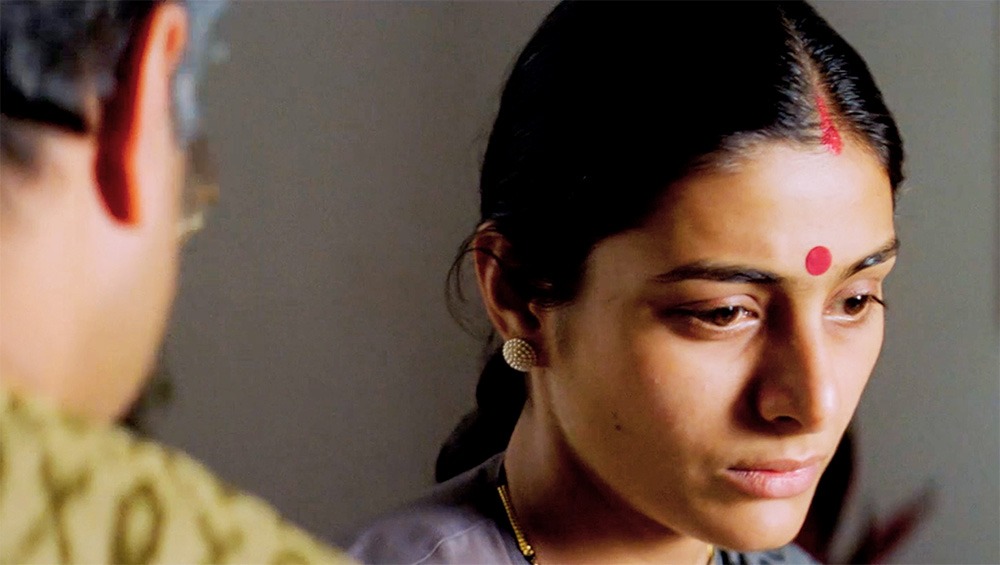
Fifty years after “Mummy” was published, the 2000 film Astitva (Existence or Being) explored similar themes of female autonomy and desire within a domestic setting. Astitva questioned, albeit in a different context and time, why desire was incompatible and unacceptable with motherhood. While Stella Jackson facilitated men’s desires, in Astitva, Aditi is in an unhappy marriage and prompted to explore her own.
Directed by Mahesh Manjrekar and made simultaneously in Marathi and Hindi, the protagonist, Aditi (Tabu) is married to Shreekant, a dominating husband and father, a patriarchal condition that Aditi accepts. Early in the film, Aditi tells Shreekant that she feels “so alone” and would like a job. Shreekant refuses, saying that no woman in his household has ever worked and he does not need his wife’s money to run his home: “Hamare gharaane mein na aaj tak kisi aurat ne naukri kii hai, na kisi ne karvaayi hai… Mujhe apne ghar mein biwi ke paise nahin chaahiye. Main apna ghar chala sakta hoon.” To date, no woman has ever held a job in our household, nor has she employed anyone… I don’t need a wife’s wages to run my home. I can do it myself.
Later in the film, Shreekant encourages her to take music lessons, which leads to her closeness with the music teacher, Malhar Kamat. As the film unfolds, Kamat leaves an inheritance for her, which prompts Shreekant to believe this is evidence of their affair.
In a 2019 study which analysed portrayals of mothers in advertisement visuals from 1950 to 2010, researchers found that in over six decades, only superficial changes were apparent in how mothers were represented. Although some advertisements depicted women pursuing careers or acquiring knowledge, these quests were consistently framed as serving the goal of being a ‘perfect mother.’ The perfect woman is a mother, and everything she must do must relate to that role. Regardless of a woman’s skills or success, her abilities were shown as extensions of motherhood, to reinforce the myth of the ideal of traditional domestic roles.
In Astitva, Aditi is expected to be the ‘perfect mother’ and not allowed to work, as Shreekant believes it will make him look inadequate. He also thinks it will dilute her attention from her maternal and wifely duties, even though their son, Aniket, is a young adult with a life of his own. Aditi’s aspirations are irrelevant, while Shreekant’s authority remains unquestioned.
When Shree publicly confronts Aditi about her affair—despite his own infidelities—he strips her of dignity and further punishes her by severing her relationship with Aniket. Prejudiced by his father’s views, Aniket rejects her. While Chadha in “Mummy” recognised Stella’s humanity, Aniket does not extend the same to his mother. Although Stella and Aditi inhabit vastly different social worlds, their stories converge on the themes of maternal instinct, desire, and the pursuit of selfhood under the constraints of patriarchy.