This is Part II of a series of articles Farah Ahamed is writing on the topic of “Other Mothers”, Part I, was published in issue n. 17 of The Dreaming Machine with the title Brokering the Link: In the Shadow of Many Mothers.
www.thedreamingmachine.com/mothering-and-other-mothers-farah-ahamed
In a conversation with a group of women I had only just met, I was told, with pity and envy, ‘You don’t have biological children, so you’ll never understand the true extent of “mothering anxieties.”’ I did not respond. I recognised that I had been ‘othered’ simply because I had not given birth.
The work of loving, guiding, nurturing, and building community falls to women in multiple overlapping roles that are frequently invisible, undervalued, or dismissed. Culturally defined ideas of motherhood constrain both women who are mothers and those who are not; yet mothering in all its forms is not limited to care for one’s own children. And why can’t we, those who have been mothering as ‘other’ mothers, or been ‘mothered’ by ‘other mothers’, or ‘othered’ for not being the ‘ideal,’ expand the definition of mothering?
The notion of the ‘ideal’ mother is stifling. Society chooses to glorify a woman as the divine mother, the source of energy, power, and fertility, while simultaneously institutionalising motherhood as a mechanism of oppression. In a patriarchal society, a woman’s status depends on producing male heirs, and her identity revolves around being a mother. There is no space for individuality. The Modernist painter M.F. Husain chose to depict the ‘ideal mother’ as one who gives unconditional love and service in his Mother Teresa series. He renders her as a faceless maternal figure in the iconic blue-bordered white sari of the Missionaries of Charity. By removing facial distinction, Husain suggests she could be any woman, and as such, any woman aspiring to such an ideal ought to be venerated.
The pressure to be a biological mother is always present. I was recently asked by a complete stranger, a man, right after we were introduced: How many children do you have? Not if I had children, which is equally disconcerting, but how many. Shocked, I mumbled, ‘None,’ not from shame but from the unexpectedness of the question. The response I received was a look of sympathy, as if the decision not to have children could not have been my choice, but rather a calamity, or that I must have some kind of physical defect. A hundred years ago, the artist Amrita Sher-Gil commented on motherhood and societal expectations. She noted how even if a woman was accomplished and independent, if she was not a mother, society marked her as a ‘failure.’
Similarly, a friend shared her experience of maternal recognition after she had conceived through IVF. She said she received congratulations, praise, and public acknowledgment of her ‘achievement’ from family and friends; yet, some years later, when she adopted a child, there was no similar celebration. This disparity reflects a societal bias: motherhood is valorised when there is a genetic connection but devalued when it occurs outside this framework. In privileging genetics, society polices and maintains the boundaries of motherhood. Adoption, like other forms of non-biological mothering, is often undervalued and invisible, even though it involves the same commitment. My friend’s narrative underscores the idea that ‘other’ mothers, whether adoptive or surrogate, are frequently ‘othered’ because their bonds are not biological.
Another friend wrote to me about how, growing up, she had been raised by her grandmother because her mother had been unwell. My friend said she never had the ‘good fortune’ to experience ‘true motherly love,’ because while her grandmother had been caring, she had also been a difficult woman. Now, decades later, my friend is a mother and also a mother-in-law with grandchildren. She said she tries to be the ‘best mother’ she could, while being aware of the loss of not having her mother’s affection growing up. In My Mother, My Self, Nancy Friday observed: “My anger has meant pain to me, but it has also meant survival, and before I give it up, I’m going to be sure that there is something at least as powerful to replace it on the road to clarity.” My friend’s story illustrates how, like Friday, she realised how pain had shaped her, and how she carried that history into her own mothering of her family.
In her novel Fire on the Mountain, Anita Desai explores how mothering is sometimes a difficult and complicated type of loving. When it is thrust on you even if it is for a loved one, it can feel like a burden, even while you recognise it is also a profound privilege. The main protagonist Nanda Kaul is a great-grandmother disillusioned with her roles as wife and mother. Once widowed, she moves to Kausali for a solitary life. This is disrupted by Raka, her great-granddaughter, who is sent to her because her mother is ill. Nanda is forced into taking care of her. “It was against the old lady’s policy to question…but it annoyed her that she should once again be drawn into a position…to be responsible for their effect and outcome. When would she be done?” After her initial reluctance, she is fascinated with Raka: “Raka, you really are a great-grandchild of mine, aren’t you? You are more like me than any of my children or grandchildren. You are exactly like me, Raka.” Yet, while Nanda recognizes their bond and Raka’s need for nurturing, she struggles to fulfil it, realizing the irony of the empty fairy tales she had once been told. In the end, she leaves Raka. Her choice underscores the tension between autonomy and maternal responsibility, showing how mothering, biological or not, is complex.
Mothering comes with many anxieties and challenges. In her painting Mother India, Sher-Gil tried to capture the reality of motherhood. Rather than depicting idealised, joyous scenes of a rural mother, Sher-Gil painted a woman with an aura of sadness or ‘indefinable melancholy’ because she wanted to highlight the harsh conditions of poverty and its impact on motherhood. In her 1940 painting Woman on Charpai, women are resting and caring for one another within the home. Their stoic facial expressions and gestures are aimed at giving women back their agency and transforming the domestic space from one of patriarchal control into one of comfort and self-nurture.
In a similar vein, Ismat Chughtai wrote about male-dominated, culturally controlled ideas of motherhood. In her work, she gave voice to the ‘hidden anger, angst, and discontent in the mothering self.’ In an interview, she explained how she convinced her father to excuse her from learning to cook and to let her pursue her studies. She recorded the exchange in her memoirs:
Her father said: ‘Women cook food, Ismat. When you go to your in-laws, what will you feed them?’
I replied: ‘If my husband is poor, then we will make khichdi and eat it, and if he is rich, then we will hire a cook.’
Chughtai explains how her father realized she ‘was a terror and that there wasn’t a thing he could do about it.’
Like Chughtai, Kamala Das in her poem An Introduction wrote about feeling stifled by instructions. She said:
‘women were expected to confine themselves to the realm of the kitchen and it was not a role entirely accepted by society. A woman had to prove herself to be a good wife, a good mother before she could become anything else. And that meant years and years of waiting.’
Frustrated, she said to those who tried to keep her encaged:
Why not leave me alone, critics, friends, visiting cousins, every one of you?
Mother-in-laws are a type of ‘other’ mothers. The traditional ‘saas-bahu’ narrative in popular culture is that mothers-in-law are not easy. In reality, of course it varies. A friend told me her mother-in-law was her best friend, sister, and ‘other mother.’ In contrast, a woman who was a mother-in-law told me how terrible it had been for her when she had been married, and didn’t see why it should be easier for her daughter-in-law. ‘That was the way it was and always will be.’ While yet another shared that because it had been traumatic for her, she wanted it to be different for her daughter-in-law. However, her daughter-in-law found the ‘non-interference’ from her mother-in-law cold and took the distancing to be a type of disapproval. ‘In-laws mothering’ is never straightforward.
In her novel Ice-Candy Man, Bapsi Sidhwa presents another form of mothering. Ayah, an eighteen-year-old Hindu nursemaid is the archetypal employed ‘other mother.’ Ayah tends to Lenny, a child with disabilities who loves Ayah “as she does her mother, father, and the rest of her family.” In her depiction of Ayah, Sidhwa exemplifies the paradox of ‘other mothers’-their labour and maternal love are essential even though it is paid, yet they are often invisible and marginalised. Growing up in Kenya, I had a similar experience. My own ayah, Mama Gladys, was a true ‘other’ mother to me. Likewise, with my nieces, Mama Rose was the first to bandage a hurt, play hide and seek, sit under a tree to count insects, and play the same game for hours without complaining. They were paid to take care of us, but their love and affection was real and no less maternal.
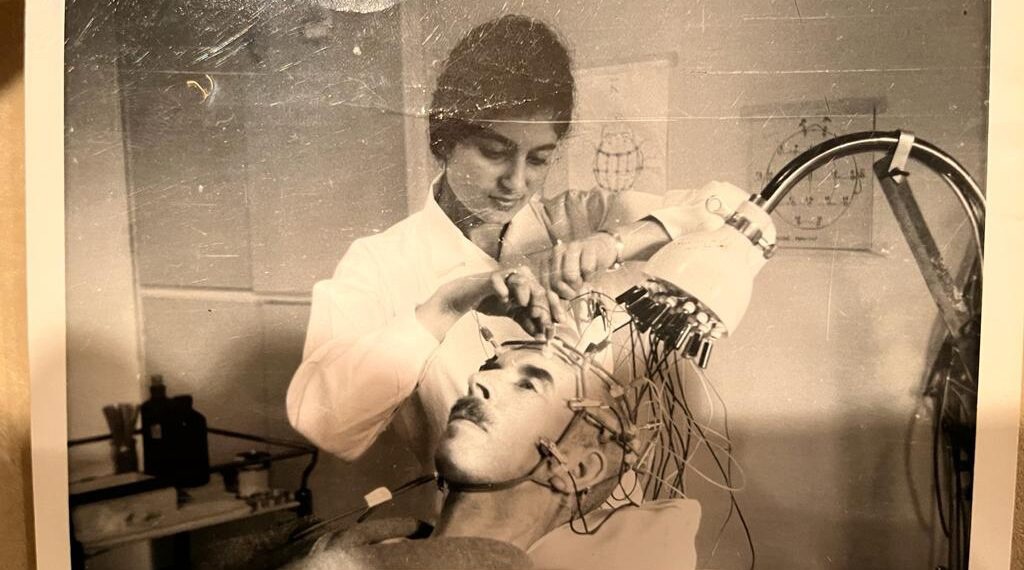
Farah Ahamed’s mother as a young woman at work, trained as a scientist she is working with early imaging technology. From the author’s personal archives.
Mothering is not always innate or effortless. The care can be shared, supplemented, and even redistributed within families, often by aunts, sisters, or other “other mothers” when a biological mother is unable to provide what her children need. In My Mother/My Self: The Daughter’s Search For Identity, Friday reflected on her mother’s insecurities and how her mother said to her:
‘I don’t feel that serene, divine, earth-mother certainty that you’re supposed to. I am unsure how to raise you. But you are intelligent, and so am I. Your aunt loves you, your teachers already feel the need in you. With their help, with what I can give, we’ll see that you get the whole mother package—all the love in the world. It’s just that you can’t expect to get it all from me.’
Growing up, I never considered my mother was mothering anyone but my sisters and me. However, I recently learnt from a cousin how my mother helped her choose her first bra, talked to her about periods, and encouraged her to pursue her professional ambitions. Beyond the family, I remember coming home from school and seeing the living room door shut, when usually it was always open. I knew from this that it was my mother’s ‘private’ meeting with her ‘women’s circle.’ Only now, decades later after my mother’s passing, I learnt how the women were ‘mothering’ each other and those meetings helped them through their most difficult days.
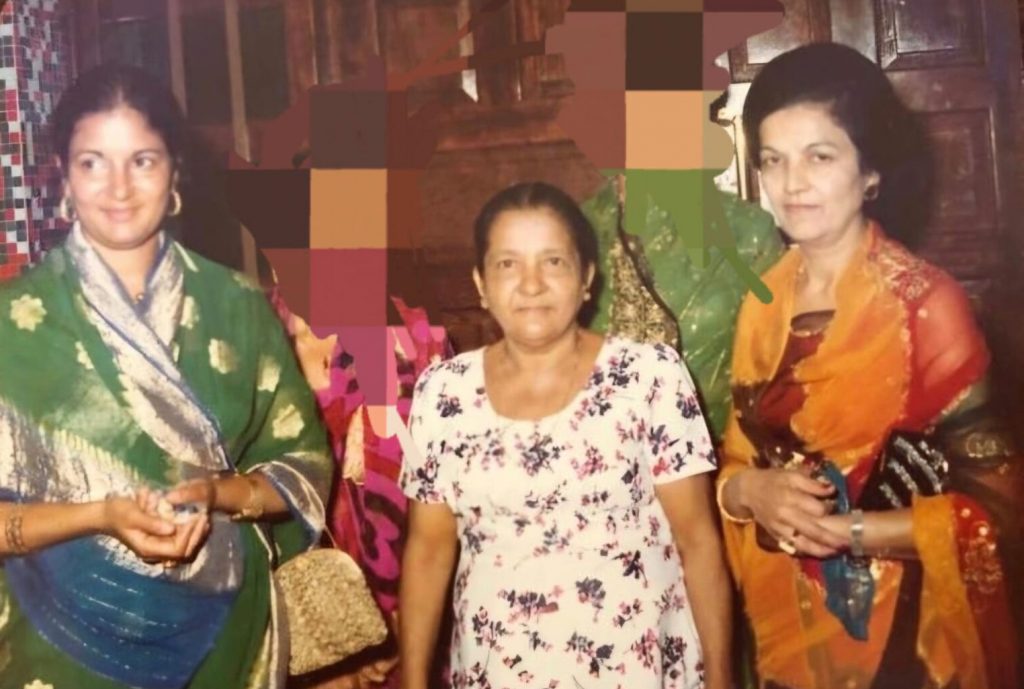
The author’s mother and the ‘other mothers’, two of the author’s aunts.
I witnessed a moving ‘other mothers’ incident in my mother’s last days. As she lay dying in a hospital bed, her sister, sisters-in-law, and nieces came to visit her from all over the world to reassure and fortify her with spiritual counsel, and remind her that she was loved, and that they were there for her daughters. My mother had been the first woman in generations of her family to receive a scholarship. After returning from the University of Edinburgh in 1967, she set up the first EEG Unit at the Aga Khan Hospital in Nairobi. Later she opened a Montessori, managed a fast-food business, and helped my father with his law firm. As part of the local community, she was the chairperson of various committees helping with projects for women and the elderly. To me, and to everyone else it seemed to me, my mother was inspired and invincible. In the turmoil of her illness, I watched how all the women in my family gathered around and mothered her.
I never imagined I would have to ‘mother’ my mother, and yet that is what I found myself doing. In that moment, I resented her for being unwell; she was supposed to be superhuman, and I took it for granted that no matter what I did or said, my mother would always be there. In a similar denial about her aging mother in My Mother at 66, the poet Das wrote:
‘…her face ashen like that of a corpse
and realized with pain
that she was as old as she looked
but soon put that thought away,
and looked out at young trees sprinting,…’
It is not easy to accept your mother’s mortality. I had to take her to the doctors, understand what was required, monitor her medicines, ensure she ate properly, rested, and received the care she needed, all while holding back my anger at the unfairness of it. It made me confront the vulnerability and fragility of the beloved woman who had appeared indomitable my whole life. Das continues about her mother in the same poem:
‘…I looked again at her, wan,
pale as a late winter’s moon and felt that old familiar ache,
my childhood’s fear,
but all I said was,
see you soon, Amma,
all I did was smile and smile and smile……’
This type of ‘reversal’ mothering also occurs between women who take on the role of ‘other mothers’ to non-biological daughters. A cousin told me about an unexpected maternal bond of love and trust that had formed when she was befriended by an older woman. When she fell ill, my cousin took her to hospital and oversaw her last rites.
Fathers can also be ‘other’ mothers. My own father had to deal with the drama that comes with three young girls growing up without their mother. He struggled: sometimes he said, ‘If mummy was here, she would know what to do.’ Nonetheless, despite his conservative background, he was open-minded, and when we were setting up Panties with Purpose, he was supportive and encouraging, even though he could never utter the words ‘panties’ or ‘pads,’ and always used the word ‘products.’
My partner also considers himself to have been an ‘other’ mother to his children when they were growing up. At Montessori with his children, he was the only man amongst all the mums, who jokingly called him “the mama.” His children never felt that their mother should have been there instead of him, underlining that nurturing isn’t gendered, but a societal imposition.
Rabindranath Tagore’s short story ‘Kabuliwala’ illustrates how a male character becomes an ‘other father’ to a young girl. Rahmat, an Afghan fruit seller from Calcutta, becomes attached to the five-year-old Mini, whom he plays with and teases, because she reminds him of his own daughter in Afghanistan. Many years later, he returns to her home from prison and finds Mini grown up and feels a profound sense of loss of those innocent years of her childhood. Through Rahmat, Tagore shows how fatherhood is not limited to blood but can include affection rooted in memory and emotional encounters.
Saadat Hasan Manto’s short stories also explored the lives of women who were mothers, ‘other mothers,’ and ‘othered.’ Mummy centres on Stella Jackson, a middle-aged Anglo-Indian woman. Manto questions how it is that Stella is a loving, maternal figure and also runs a brothel. Surely the two are incompatible as she is exploiting the very girls she is also protecting. And how deserving is her title of “Mummy”? At the story’s climax, Stella prevents Chadda, her best client, from taking advantage of Phyllis, a naïve fifteen-year-old girl, and asks him to leave. A few days later when Chadda is sick, Stella nurses him back to health. In giving Stella her humanity, Manto highlights how easy it is for a society, which is largely hypocritical, to castigate women who do not conform to their narrow ideas of mothering and motherhood.
A night guard in Mombasa told me a story about the worst mother he’d ever come across, who was married to a ‘beach boy.’ A white man, a tourist, approached the beach boy and asked him to find him a woman and he would pay ‘good money.’ The beach boy ran home and convinced or forced his wife to return with him. Money was exchanged, and the wife and the white man departed together. The following morning, the wife did not return. There was no sign of her in the days that followed. The beach boy was left looking after their three children. My narrator said he couldn’t believe how ‘evil’ the woman had been. I replied, ‘But didn’t her husband sell her to the tourist?’ He shook his head. ‘Still, how could a mother leave her children behind?’ For him, a man’s sins, no matter how grave, could be excused, but a mother abandoning her children was unforgivable. The story reminded me of how a woman’s worth is measured by her capacity to unconditionally nurture and sacrifice for her children. Any deviation from this ideal, no matter the circumstances, is a profound failure. As Das described in her poem, society continually demands that women should conform in order to fit the mould.
‘Dress in sarees, be girl. Be wife, they said. Be embroiderer, be cook, Be a quarreller with servants. Fit in. Oh, belong, cried the categorizers.’
Extending this argument from human relationships to lived geography, place itself can also function as a form of mothering presence. This maternal dimension is powerfully echoed in Fehmida Riaz’s work, where she refers to Delhi as her “mother,” mourning the city that she had to leave which had nurtured her artistic spirit. In a poem written as a tribute to Delhi she personifies the city as her mother who embraces her street by street, asking Riaz who she really was, and Riaz replies, ‘I am your daughter, but in a new guise,…. in my veins runs your blood
but my tears are my own…you are bound to me by womb-connection (translated from Urdu.), closing with a prayer:
“Tu sada suhaagan ho maañ ri”
May you always remain fulfilled, O Mother,
For Riaz, Delhi is a living, beloved presence.
Every time I return to Kenya, I feel a sense of being mothered by the environment—the smell of the earth, bougainvillea bushes, weaver birds, and sound of rain immediately evoke a memory of childhood. This sense of place as nurturing is not only abstract but deeply sensory and embodied. It is a return to something that holds and sustains me.
The poetry of Iftikhar Arif extends this logic of memory and everyday geography; a street functions as a quiet maternal presence in his ghazal Dilli:
“Usi gali mein mujhe laut ke jana hai jahan…”
I must return to that same street where…
The gali in Delhi is transformed from a mere physical location to a space filled with warmth, familiarity, and belonging. This remembered place continues to call Arif, much like a mother whose influence persists even in absence. The poetic visions of Riaz and Arif show how an intimate street or a city can embody the qualities of mothering, offering origin and a sense of return.
Mothering takes many forms and extends far beyond biological bonds and ‘other mothers’ appear along the way when we need them, to reassure, guide, inspire, and console. These stories- drawn from South Asian literary texts and visuals- do not offer a single definition of motherhood but show how mothering is expansive. In recognising this, a definition of motherhood emerges which is not biological, nor ‘ideal,’ but one that is dynamic and rooted in kindred resonance, empathy, and memory and continually remade- across people, places, and time.