In the Shadow of Many Mothers
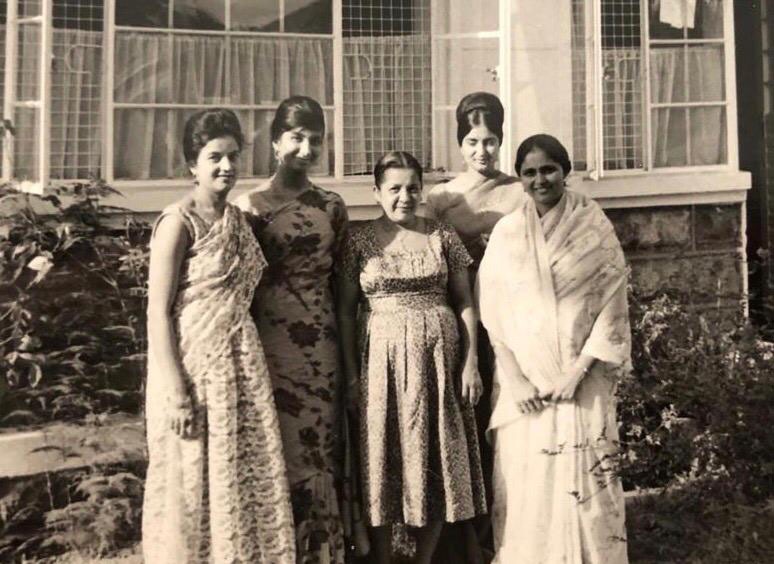
Photo from Farah Ahamed’s personal archive; the author’s mother is the 2nd from right, back row, and the author’s ‘other mothers’. Photo taken circa 1960.
This year I turned the age my mother was when she died twenty-six years ago from a sudden, short illness. This month, had she been alive, she would have turned eighty-one. I do not have children, but I found myself reflecting on what it must have been like for her as a mother, knowing she was dying and leaving behind three young daughters. But growing up in Kenya and belonging to a community ensured that ‘other mothers’ stepped in to fill the void. These women helped me navigate my life experiences.
Recently I saw a call for submissions from an Indian feminist journal on the theme of ‘motherhood,’ and so I queried the editor with an article about ‘other mothers.’ However, the editor rejected my piece on the basis that ‘motherhood was a sensitive topic’ and, assuming that I was not a biological mother, she considered my writing an ‘appropriation’ of motherhood. The editor also added that the journal’s definition of motherhood was restricted to ‘biological mothers’ and they believed any widening or deviation would be anti-feminist.
Her response stunned me. The core of my essay was to challenge rigid definitions of motherhood and honour the many other women who mothered me. To be told that my lived experience did not qualify as legitimate struck me as both narrow and deeply ironic—especially from a feminist space I had believed would welcome complexity and nuance. It made me question: who defines motherhood? The rejection reaffirmed why writing stories about ‘‘other mothers’ matters; to resist and argue against traditional definitions rooted in patriarchy. But also, it reinforced my understanding that the legacy of mothering isn’t limited to wombs; it lives on in the hands that braid hair, the voices that offer wisdom, and the hearts that hold space for others to heal.
It is not often that we pause to honour the many non-biological mothers who influence our lives in quiet, profound ways, or the diverse types of maternal bonds they create and nurture. Patricia Hill Collins calls them ‘other mothers’ or women who parent children who are not their own. She explores the notion of ‘mothering the mind’ and how relationships between the ‘other mothers’ and the women they mentor develop to form bonds of a shared solidarity of what it means to be women living at a certain time and belonging to a community.
The poet Nikki Giovanni mentions the critical influence of many diverse women in her life, beyond her biological mother, including her grandmother, aunt, and sister. She acknowledges the ‘other mothers’ from the wider community who provided her nurturing, counsel, and love. She particularly refers to her mother’s sister, Aunt Ann, who often took on the role of mothering her and providing guidance. Similarly, my favourite ‘other mothers’ were my mother’s sisters or ‘masis,’ as they are called in Gujarati, and my ‘mamis’ or my aunts married to my maternal uncles. They were the ones who prepared my favourite desserts, defended me against my mother, bought me presents, dolls, dresses, shoes, and books, sent me parcels of food at university, and told me stories about the family. My aunts would do anything for me, but they were the ones I also secretly envied, because whenever they were there, my mother seemed remote from me, involved in her own world with them. I saw them exchange looks which only they understood, and spoke a private, coded language which excluded me.
My mother’s and masi’s dynamic with me was further layered. My maternal grandmother and my eldest masi were pregnant at the same time, and my mother and her niece were born days apart. This meant that my masi treated my mother was treated as though she were her own child, because my mother was the same age as her own children. My masi was more like a grandmother figure, because my grandmother was not alive, but many years later, the same masi told her daughters, my cousins, in the days before she passed, that I was as good as her last born. And even now I am included as one of them – although they are as old as my mother would have been. What has evolved over three generations, across continents, space and time is a profound, loving relationship of loving, nurturing and other mothering.
Now years later, I find myself a masi to half-a-dozen nieces. In my own way I have encouraged their activism, involved them in dinner table discussions on political issues and human rights, suggested films and books and tried to show them how they have a unique contribution to make wherever they are, in their own way. Through teasing, shopping, dancing, cooking and spending days lying on the grass in the sun imagining shapes in the sky, together we have fortified and reaffirmed the ‘other mother’ multi-generational bond.
Related to the idea of caring mother-aunt-like figure was also the woman who was employed to tend to my needs while I was a young child, whom I called Mama Gladys. Admittedly a very context-specific experience, this ‘auntie’ made sure I was fed on time, bathed, and followed me around the house and garden, playing with me until I was old enough to be left on my own. If I fell and got hurt, she was the first to comfort me and cover my knee with a band-aid.
Another kind of ‘other mothering’ is often from an older sister who takes her role very seriously. In fact, even though I am not that much older than my siblings, after my mother died, my role as the eldest also took a maternal, protective instinct. Often my sisters protested, ‘But you’re not always right, and you don’t know everything.’ I never claimed that I did, but in the absence of my mother, what else could I do but try and understand my sisters as best as I could, under the long gaze of my mother’s shadow?
Beyond family I have found ‘other mothers’ in unexpected places. Some were women I admired from afar, yet who shaped me in profound ways. My mother’s best friend was another ‘other mother,’ and when my mother died; she was the first to show up on our doorstep with chicken pasta, and even now, still bakes and cooks my favourite sweets for me.
For bell hooks too, the idea of ‘other mothers’ extended beyond biological ties to include the type of bonds nurtured by women who inspired communal and political activism. She argued that it was patriarchy that confined motherhood to the narrow role of the biological mother. She saw the ‘other mother’ paradigm as a radical reimagining of motherhood—one where childcare responsibility was collective and shared. She believed this was essential to building a society that was just, resisted patriarchy, and rooted in communal love.
Her explanation reminds me of a friend’s grandmother whom I befriended shortly before my mother passed. Our bond was instant. Every week she phoned to ask how I was, tell me about her friends, some of whom were long dead, and explain what it was like to be an independent woman and drive a car in the 1960s in Kenya. When I was going through a divorce, she motivated me to think beyond my constraints and carve out a different future.
A few years ago, a woman I met briefly, only once, has become a fast ‘other mother.’ Age is irrelevant, as does the fact that we have never sat face-to-face across from each other. But our daily exchanges of poetry, links to music, and images of the sky, trees, and flowers, as well as her counsel and reminders of faith, have kept me grounded through my most turbulent times.
There is a group of ‘other mothers’ that is often forgotten, according to Alice Walker. These are the truth-tellers; the women poets, writers, artists, musicians, and trailblazers who light our paths with their words and songs. For me it has been Shashi Deshpande, Ursula le Guin, Doris Lessing, Ismat Chughtai, and many others including Rebecca Lloyd. She became my writing mentor quite by chance, when we met on the internet fifteen years ago. It was her vision that has helped me develop my writing instincts and voice. She has inspired me to write, resist, and reimagine the world. Maya Angelou also acknowledged the role of such ‘other mother’ figures in her life, including her grandmother and Eleanor Roosevelt.
Poet Giovanni often referred to her best friend Rosa Parks as a type of ‘other mother,’ a person she often turned to in times of need. My best friend, similarly, has been an ‘other mother.’ I have relied on over decades. When I needed trusted advice, she was the one I turned to. When I was exhausted and fed up, it was her house where I crashed. Our first encounter with boys, drinks, and cigarettes behind the lockers at school, laid the foundation for a life-long nurturing, and who knew then, a type of ‘other mothering’ friendship.
Michelle Obama was often referred to as ‘mom-in-chief,’ because in embracing a communal maternal role, she offered Black American women the hope of a more progressive politic. Sara Hayden argues that Michelle ‘illustrates the complex nature of contemporary assumptions about motherhood.’ A New Yorker essayist asked Toni Morrison, and she said: ‘We know that it is problematic, or maybe just self-indulgent, to claim her as mother. And yet, if the business of mothering is to broker the link between two generations, then what else can she be?’
Love has a transformative power, and the love we receive from all incarnations of ‘other mothers’ epitomises this. Each of these women, my aunts, caregivers, friends, mentors, and storytellers, offered something unique: tenderness, protection, wisdom, rebellion, and joy. As Adrienne Rich said, “We are, none of us, ‘either’ mothers or daughters; to our amazement, confusion, and greater complexity, we are both.” And perhaps, in holding space for others, in offering comfort, truth, or protection, we all become someone’s ‘other mother.’
Published by The Dreaming Machine, 2nd December 2025
www.thedreamingmachine.com/brokering-the-link-in-the-shadow-of-many-mothers-farah-ahamed