The oldest surviving statue of a female dancer in South Asia is the ten-centimetre-high bronze figurine ‘Dancing Girl’ from Mohenjo-Daro, Indus Valley Civilization (2,500-2,000 BC). The contrapposto pose, the weight on one leg, the forward-protruding hip, and the bent elbow are reminiscent of a Bharatnatyam pose. Given her teenage age, provocative posture, and jewellry, I wondered: for what kind of dance had she dressed? Could it perhaps have been a menstrual dance? Sampradaya is Sanskrit for ‘evolving tradition’. I wonder if something similar applies to menstrual dances, if they even exist.
Modern menstrual dance
The idea that you can use dance to interpret and convey the movements of the menstruating body occurred to me while editing Period Matters: Menstruation in South Asia. I contacted Pakistani classical dancer Amna Mawaz Khan and asked her if she could interpret the menstrual cycle based on her own experiences and classical Indian raags (a framework of sounds).
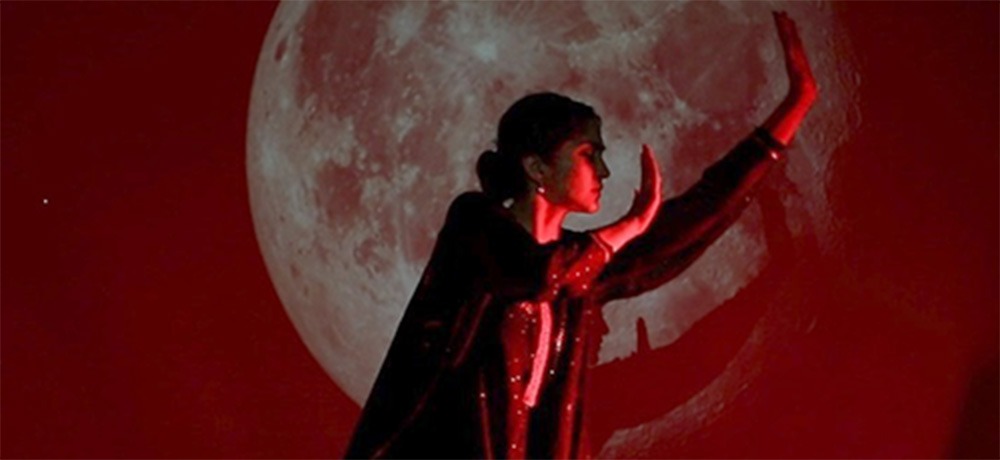
Using Bharatanatyam and Kathak forms, she created a choreography in which she sought to rediscover an ‘imaginary ancient menstruation dance tradition.’ Through rhythmic movements involving nrittya (expressive) and nritta (technical) dance steps, she conveys how her menstruation experience encompasses humiliation and shame, confusion and anger, and sometimes even disappointment, when it marks the end of a fertile period. Her dance, Raqs-e-Mahvaari , focuses on expressing shame and strength through rawaangi (flow), mudras (hand gestures), and foot movements. Through her dance, she also expresses her resistance to the patriarchy—which perpetuates menstruation myths.
Through pushing and pulling, slow, flowing hand gestures, a steady rhythm and a smooth step, raised arms, and turning movements, she mirrors the initial phase of menstruation. As heat and intensity increase in the body during the menstrual cycle, she demonstrates this with swirling bhramari chakars, or circles, which she draws on the floor with red paint and her feet. The entire dance emphasizes a divine, feminine energy that is permanent. Amna’s dance is a contemporary solo, a personal interpretation of menstruation. (…)
Religious rituals
Classical dance forms provide insight into how religious rituals and the female body are intertwined through performance art. Menstrual dances appear to be rare in South Asia due to religious and cultural myths that view menstruation as impure and private rather than something to celebrate. The disappearance of matriarchal societies and conversions by missionaries may have contributed to the suppression of dance rituals honouring fertility.
Patriarchal norms, deeply rooted in Brahmanical Hinduism and Islam, associate menstruation with impurity and banish women from public places such as temples, funerals, and weddings during their period. This restriction of freedom of movement during menstruation translates into a suppression of any form of expression. In Buddhist Bhutan, menstruating women are excluded from Tshechu dances. Where examples do exist, they often involve rituals honouring fertility, puberty, or seasonal cycles, rather than menstruation.
Feminist perspective
Like Amna, the Indian artist Mallika Sarabhai also uses bharatanatyam in her work Shakti. From a modern, feminist perspective, she combines ritual and classical dance forms to illustrate the embodiment of the goddess and the feminine, rather than the masculine. A red sari symbolizes blood, violence, and rebirth, reflecting the universal primal force of Shakti (the representative of feminine energy in Indian mythology).
Spiral arm movements and undulating movements on the floor mimic the cycles of menstruation and childbirth, while simultaneously undermining the pure geometry of Bharatanatyam. It is Sarabhai’s intention to critique established rituals by integrating ‘gestures from daily life and martial arts’. Her dance reinterprets goddess myths by portraying Shakti, Devi, Kali, and Sita as ‘raw, revolutionary female forces’ resisting the patriarchy. In the climax of her dance, her red sari is soaked, her tongue sticks out of her mouth, and her eyes roll to embody the heyyam ; the raw peak of Kali’s ferocity.
Incantation ceremony
Sarabhai’s work is inspired by Mutiyettu Theyyam from Vannan, Kerala, a ritual that portrays the menstruation dance as a unique blend of devotion, myth, and communal celebration. Mutiyettu, or the ritual of embodying Badrakali (the name of the goddess Kali during her menstruation), is depicted through wild stomping and hand gestures, or mudras. Theyyam, the incantation ceremony, is performed by a male dancer who spins in a trance and makes abhinaya (expressive eye contact) to symbolize the ferocity of the goddess Bhagavati during her menstruation.
The performance takes place in a temple or sacred grove. After many hours, the male dancer enters a trance. He stamps his feet, swings a sword, and jumps through the fire to demonstrate the energy of Bhagavati. His face is painted, and he wears a crown and a red loincloth as a symbol of menstrual blood. His circular movements symbolize cyclical renewal, while the red cloth symbolizes the fertility of the earth. The communal chant contains the phrase: ‘Her blood is life. Her cycle is sacred. Her power protects us.’
The vannan dance, although performed by a male dancer, emphasizes the divine feminine during menstruation. There are four hundred variations of theyyam , but only the mutiyettu is connected with menstruation symbolism.
Transition to fertility
The Bison Horn Maria tribe in Bastar, Chhattisgarh (India) also has a menstruation dance known as the Lingo Pen ritual. When a girl gets her first period (rajswala or pen puja), she is secluded in a hut or gondola. When her period is over, she is washed and adorned with mahua flowers, beads, cowrie shells, peacock feathers, and a red sari. These symbolize her transition to fertility. She is then placed in the center of the community, which surrounds her in a joyful dance. The men wear headdresses of bison horns and perform hulki (stamping) and saila (stick fighting). Accompanied by dhol drums, flutes, and bison horns, the phallic deity Lingo is invoked to bless the girl’s fertility.
Other Indian tribes in Kondagaon and Narayanpur perform similar dances in honor of menstruation as a sacred, communal milestone. Yet another example can be found among the Ho tribe in Singhbhum, Jharkhand (India). The Mage Porob takes place after the girl with her first menstruation has spent seven days in seclusion in a kurmi ghar, or menstruation hut. As with the Lingo Pen ritual, the girl enters the dance after being washed; dressed in a white sari, with rice paste on her forehead and flowers in her hair.
Unlike Lingo Pen and Theyyam, the Mage Porob is led by women dancing in circular formations, symbolizing the renewing life cycle. Accompanied by drums, flutes, and songs honouring menstrual blood as life-giving, men also dance along with sticks to honor Dharti Mai, or Mother Earth, for her fertility. These tribal menstruation dances differ significantly from Raqs-e-Mahvaari, in which dancer Amna Mawaz Khan herself took centre stage, interpreting and embodying her own experience with menstruation as feminine power. The girl being initiated during tribal communal dances sits passively in the centre while the community dances and celebrates her transition to womanhood.
Spontaneous initiation
The motivations for these forms of menstruation dance are totally different, as are the movements, and that reminded me of something else. (…) When my niece got her period for the first time in Kenya, she was at school camp. She told her teacher, who gathered a few other girls and asked them to surround her. What followed was a spontaneous initiation dance. My bewildered niece, who had always feared her period, realized that it was now being celebrated. Could you call such an unplanned, joyful, and memorable rite of passage a menstruation dance? And do places exist where such dances take place?
Reinvention and reconquest
These evolving menstrual dance forms, from the provocative contrapposto of the Dancing Girl to Amna Mawaz Khan’s solo Raqs-e-Mahvaari, the trance-like ferocity of Mutiyettu Theyyam, the communal circles of Lingo Pen and Mage Porob, to the spontaneous joy of the bashali gatherings, outline a sampradaya, or evolving tradition of reconquest, reinvention, and resistance.
Where the menstruating body was previously confined to seclusion and shame, it now chooses to express itself through movement: hip movements defying patriarchal norms, swirling chakars symbolizing cycles of blood and renewal, stomping feet invoking divine wrath, or spontaneous circles breaking through isolation. With every turn, every mudra, every collective step, women embody the rhythm of their own flow, as the primal pulse of life, and demand that the world make room for their power.
Sources:
- C. Mohanty fieldwork (1970s); GN Devy oral archives (2000s); Adivasi Ekta Manch reports (2024)
- Rich Freeman, Purity and Violence (1998); Bindu Ramachandran fieldwork (2008)
- Verrier Elwin, The Maria and Their Ghotul (1947); IGNCA films (1990s); Tribal Research Institute, Chhattisgarh (2023)
Published: www.period.nl/quotes/evolutie-van-de-menstruatiedans
Date: 10th April 2026
Translation: Google